PP · mostly void · over 40 years
Rainwater Storage Module
A polypropylene block that is mostly void, stacked on site into an underground tank for attenuation, harvesting or infiltration.
 Wanlihe
 Products
Applications
Guides
FAQ
Products
Applications
Guides
Standards
FAQ
Products
Applications
Guides
FAQ
A rainwater harvesting system treats rain as a resource instead of a nuisance. Water that falls on a roof or a hard surface is captured, held, and drawn back off when it is needed. That cuts the mains water bill and cuts the volume leaving the site at the same time. The tank decides how much can be kept, and the wrap decides whether it is kept at all.
Harvested water is not drinking water, and it does not need to be. The demand it usually serves is the demand that does not require potable quality: irrigation, vehicle washing, toilet flushing, and wash-down.
That matters to the sizing. A harvesting tank is sized by the demand it has to meet between rainfalls, not by the roof area alone. A tank sized only on the roof will fill and overflow during most storms, and the volume that actually gets reused will be small.
An attenuation tank holds water for hours. A harvesting tank holds it for weeks, sitting against the module the whole time, and then the water is used.
The polypropylene we mold does not precipitate anything into the water after immersion, has no odor, and resists strong acid and alkali. Those are the properties that matter when water is held for a long period and then drawn off.
A harvesting tank needs more built into it than a tank that only holds water. A pump position has to be left clear so the water can be drawn off. An inspection well has to reach the tank so the level and the condition can be checked. A pre-tank filter is usually needed as well, because roof runoff carries grit and leaf litter that will settle in the tank.
All of it goes into the module layout before assembly starts. A buried tank cannot be altered afterward, and the access that was not built is the access that will never exist.
Guidance is clear that a geocellular system generally provides no water quality treatment of its own, and that a buried system can be difficult to monitor and to maintain.
On a harvesting job that means two things. The filtration has to happen before the water reaches the tank, not inside it. And whatever the filter catches has to be reachable, because it will need clearing.
Neither is a reason to avoid the system. Both are reasons to design the access properly, which is cheaper than fixing it later.
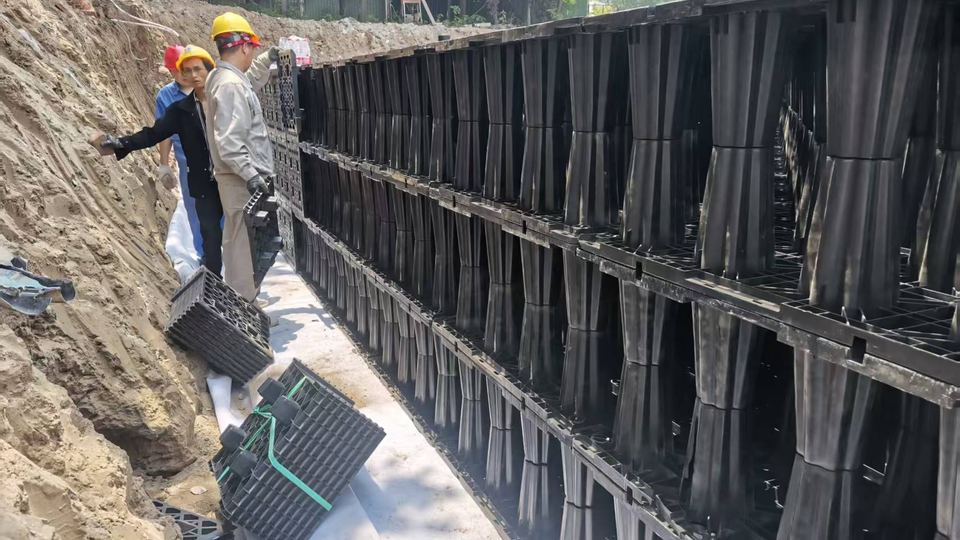
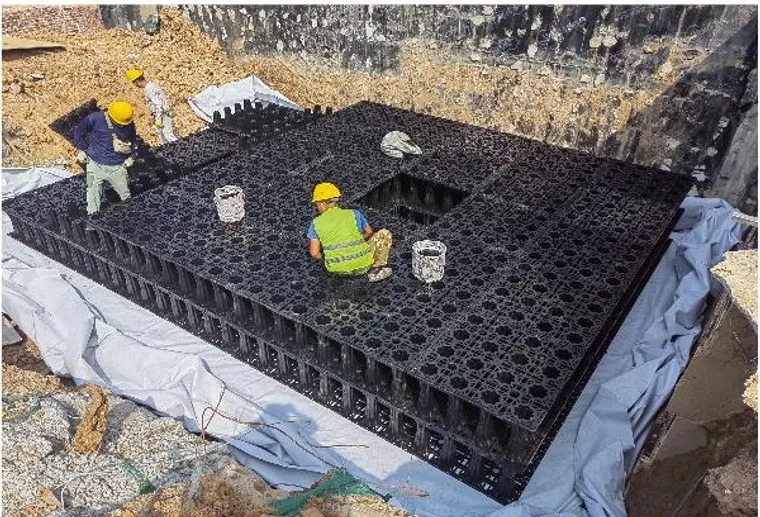
Tank assembled on site
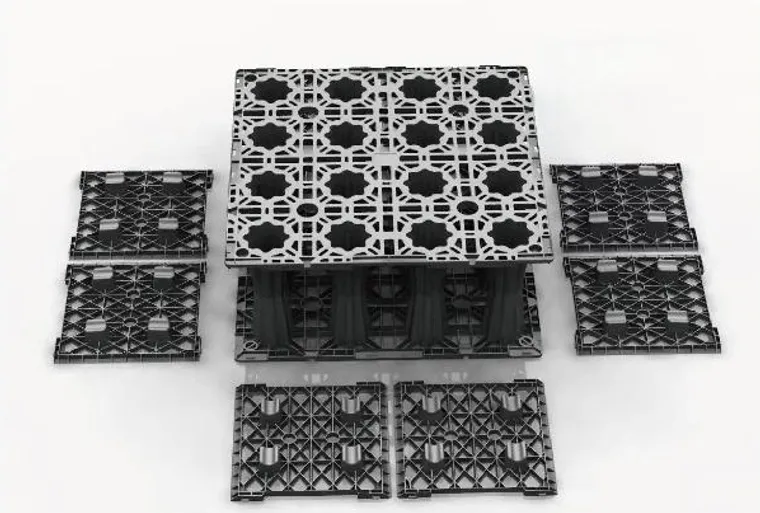
Single module
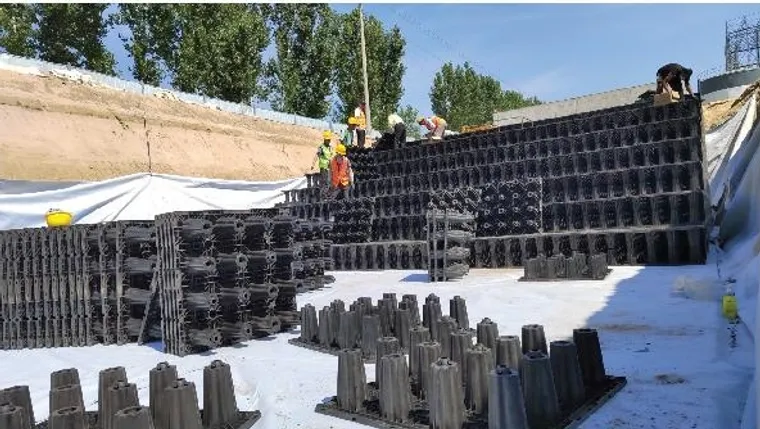
Tank being assembled
PP · mostly void · over 40 years
A polypropylene block that is mostly void, stacked on site into an underground tank for attenuation, harvesting or infiltration.