PP · mostly void · over 40 years
Rainwater Storage Module
A polypropylene block that is mostly void, stacked on site into an underground tank for attenuation, harvesting or infiltration.
 Wanlihe
 Products
Applications
Guides
FAQ
Products
Applications
Guides
Standards
FAQ
Products
Applications
Guides
FAQ
Rainwater storage systems earn their place by what they free up. A tank above ground takes land you could be building on or selling. Buried, the same volume sits under a car park, a road, or a play area, and the surface carries on earning. We make the module the tank is built from: a polypropylene block that stacks with the ones around it and turns an excavation into a storage volume.
PP · mostly void · over 40 years
A polypropylene block that is mostly void, stacked on site into an underground tank for attenuation, harvesting or infiltration.
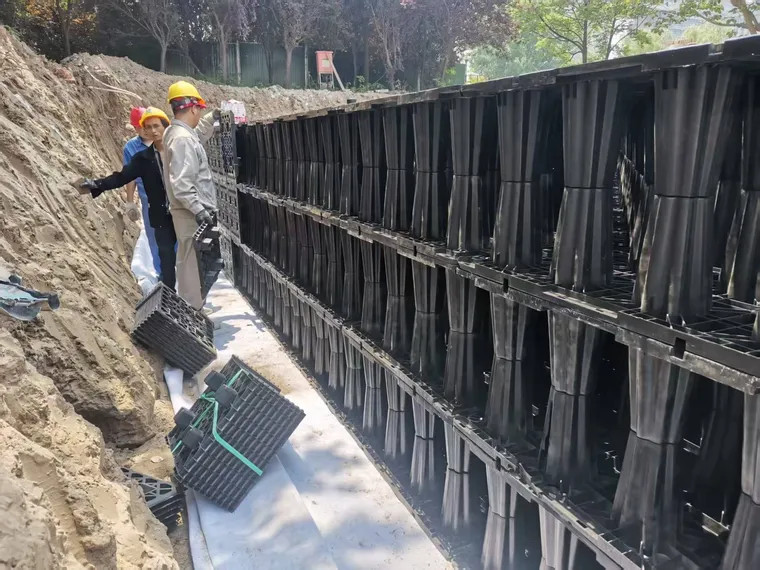
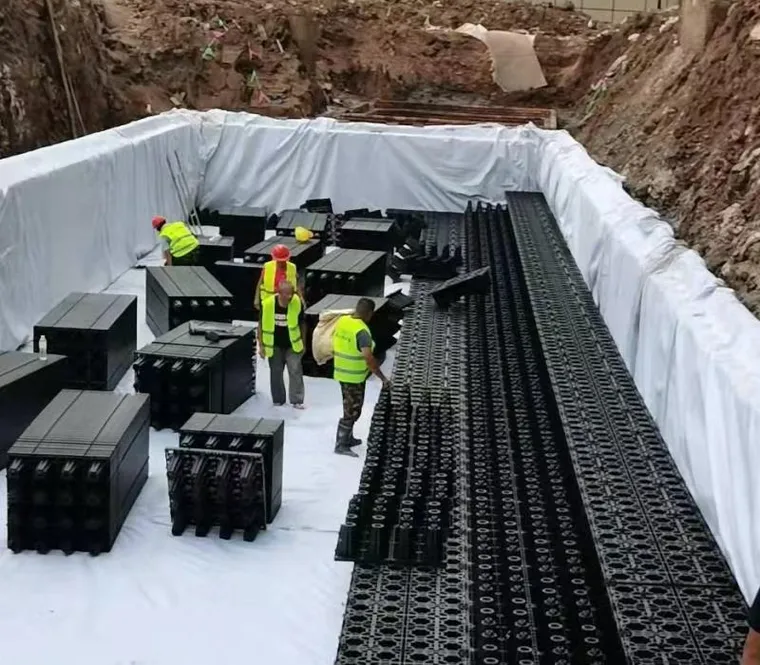
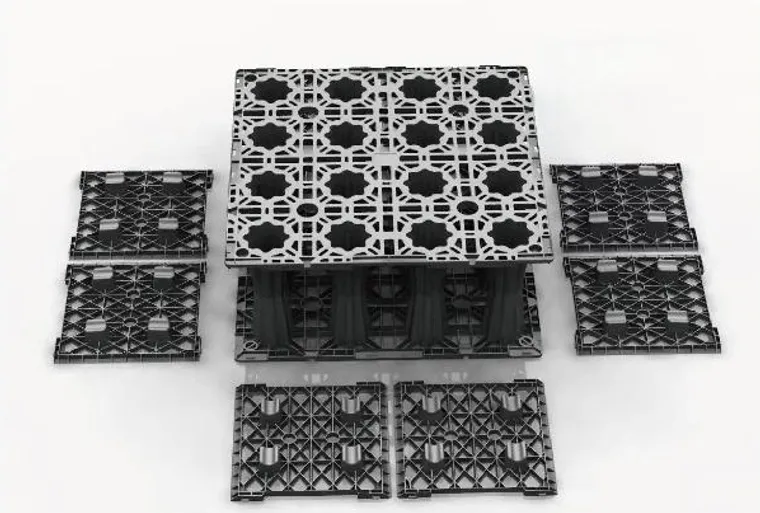
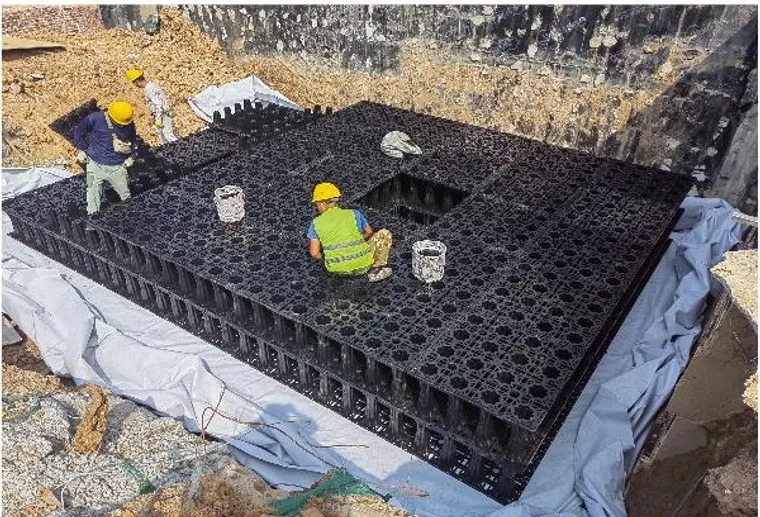
Modules assembled in the excavation
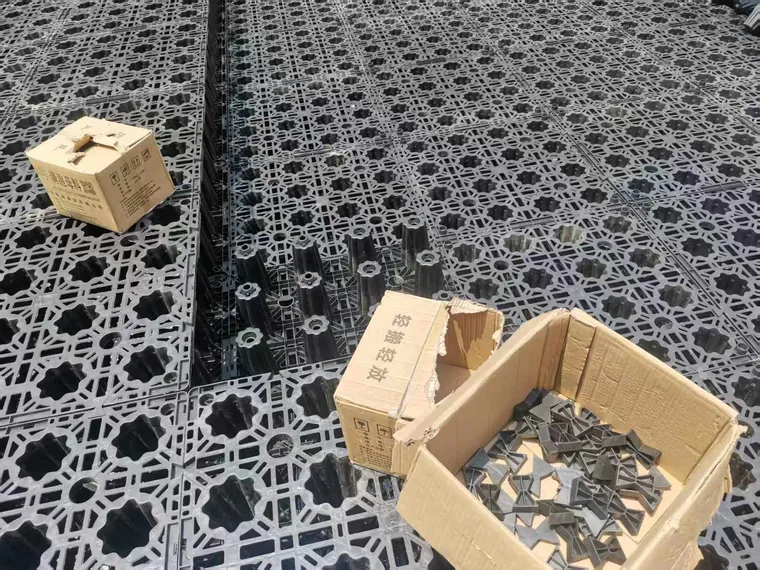
Single module
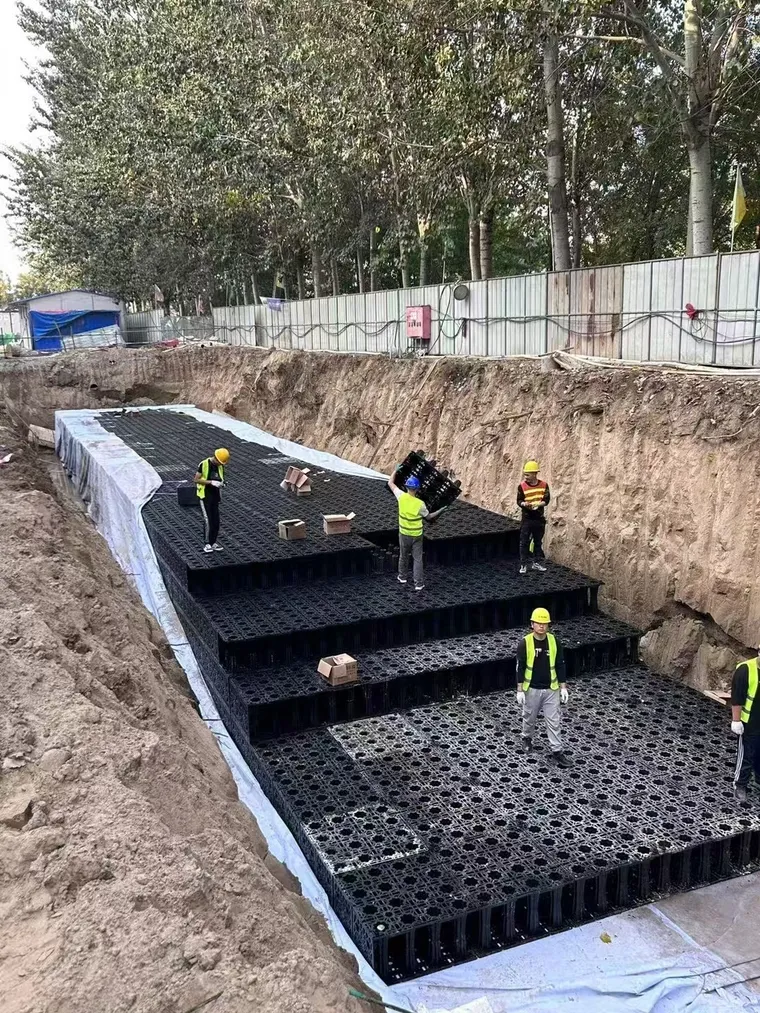
Tank assembled on site
Most sites that need one of these have the same two constraints. Rain arrives faster than it used to, because the ground that used to absorb it is now covered. And the drain the site discharges to was sized for the fields that were there before.
Attenuation is how a development squares those two facts with a planning authority. The site holds its own runoff back and lets it out at a rate the downstream drain can accept. That is a condition on the development, not an optional extra.
The second constraint is space. A tank on the surface takes land. Buried, the tank takes nothing that was otherwise usable, and the surface above goes back to parking, road, or planting.
A geocellular system is generally defined by its shape rather than its material. It is a stack of modular units, and the voids inside them hold the water. That makes it different from a tank in the ordinary sense, because there is no vessel: the storage volume is the gap between the plastic.
Two consequences follow. The system can typically be shaped to fit the excavation instead of the excavation being dug to fit a fixed box. And the storage volume is a high proportion of the system’s bulk, so the hole in the ground is smaller than a chamber of the same capacity would need.
The same modules serve three different jobs, and what separates them is the wrap and the connections.
Attenuation. The tank is wrapped so water goes in, sits, and leaves at a controlled rate through an outlet. Nothing is kept. The tank exists to delay the flow reaching the drain.
Harvesting. The tank is wrapped to hold water, and the stored volume is drawn back off for reuse. The saving is on the water bill, and the runoff leaving the site is reduced at the same time.
Infiltration. The tank is wrapped in geotextile and lets water out into the surrounding ground. The soil does the disposal, and there is no outlet at all.
This is worth being straight about, because a buried tank is hard to change later.
Independent guidance rates geocellular systems well on peak flow reduction and on managing high flow events. They are generally lightweight, straightforward to install, and robust once in place. They can generally go under trafficked ground where the structural performance has been shown to be adequate, and they are typically suitable beneath public open space.
The same guidance is clear about the limits. A geocellular system generally provides no water quality treatment and no amenity value of its own. Its performance is typically difficult to monitor once it is buried. And it can generally be difficult to maintain.
None of that rules the system out. It means the treatment and the access have to come from somewhere else in the design, and that is a decision to take early rather than discover later.
Guidance generally treats the component as suitable for residential, commercial, and industrial sites, for high-density layouts, for retrofit, for contaminated sites, and for sites above vulnerable groundwater. In practice the constraint is rarely the site type and almost always the depth available and the load above.
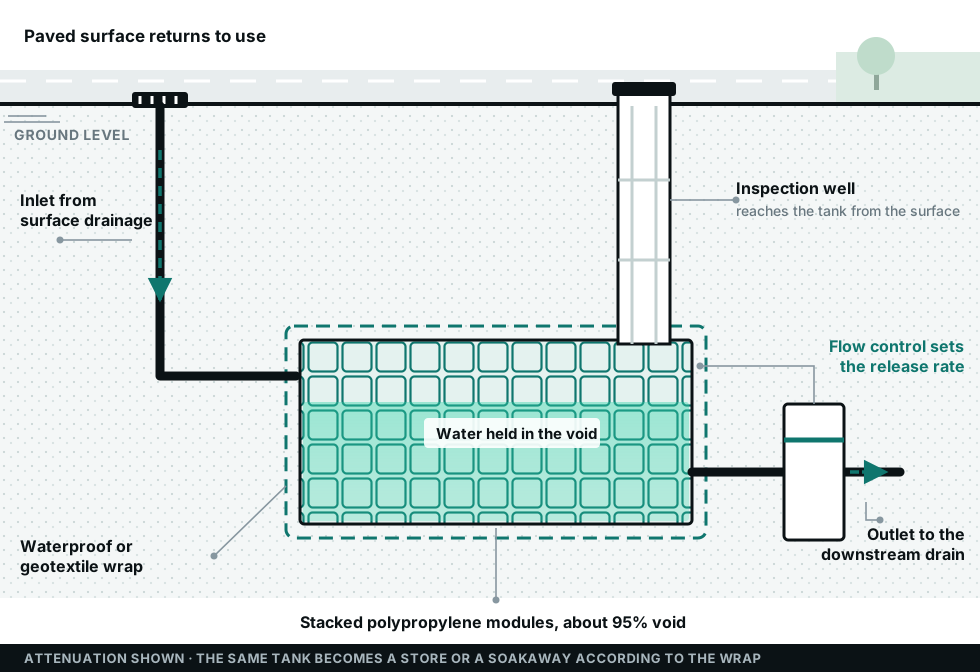
Three numbers fix the tank. The volume comes from the area draining to it and the storm the site is designed against. The depth comes from the excavation, and it sets how many modules stack on each other. The load comes from whatever the surface above will carry once the tank is buried.
Get those three wrong and the tank is either too small to do its job or too weak to survive the site. Get them right and the rest of the design follows.