GB/T 17638 · 100–800 gsm · to 25 kN/m
Nonwoven Geotextile
Needle-punched staple fiber fabric to GB/T 17638, from 100 to 800 gsm, for separation and filtration.
 Wanlihe
 Products
Applications
Guides
FAQ
Products
Applications
Guides
Standards
FAQ
Products
Applications
Guides
FAQ
Geotextile filtration is about a filter that does not block. A drainage system that silts up has not failed visibly; it has simply stopped passing water, and by then it is buried. The fabric has to be fine enough to hold the soil in place and open enough that the fines which do reach it keep moving rather than collecting.
A filter has to do two things at once, and they are in tension.
It has to retain the soil, which means its openings must be small relative to the particles it is holding back. And it has to keep passing water, which means its openings must not be so small that they blind over.
Get the first wrong and soil washes into the drain. Get the second wrong and the drain fills with the soil that was supposed to stay put. Both failures look the same from the surface, which is to say they do not look like anything at all.
The equivalent opening size is the property that governs retention. Across our range, both fabrics are quoted at an O90 to O95 of 0.07 to 0.2 mm.
Vertical permeability governs how freely water crosses the fabric, and it is quoted as K x (10-1 to 10-3) cm/s, where K is between 1.0 and 9.9. Both fabrics carry the same figures.
Note that the opening size does not change with mass per unit area. The filter behavior is fixed across the range, so the mass can be chosen on strength rather than on filtration.
A geotextile does not only pass water through its thickness. It also conducts water in its own plane, which is what discharges excess liquid and gas out of the soil structure rather than letting it collect behind the fabric.
On a drainage trench or behind a retaining structure, that in-plane flow is often what the design depends on. A fabric specified only for its opening size, with no thought to how the water leaves once it has crossed, is half a specification.
A geotextile is permeable by definition, so it is not a barrier. Where the job needs to hold water rather than filter it, the layer is a geomembrane.
The two are frequently used together, and the arrangement is a good one: the membrane does the containing, and the fabric protects the membrane from the ground it sits on. Specify them as a pair and the roles stay clear.
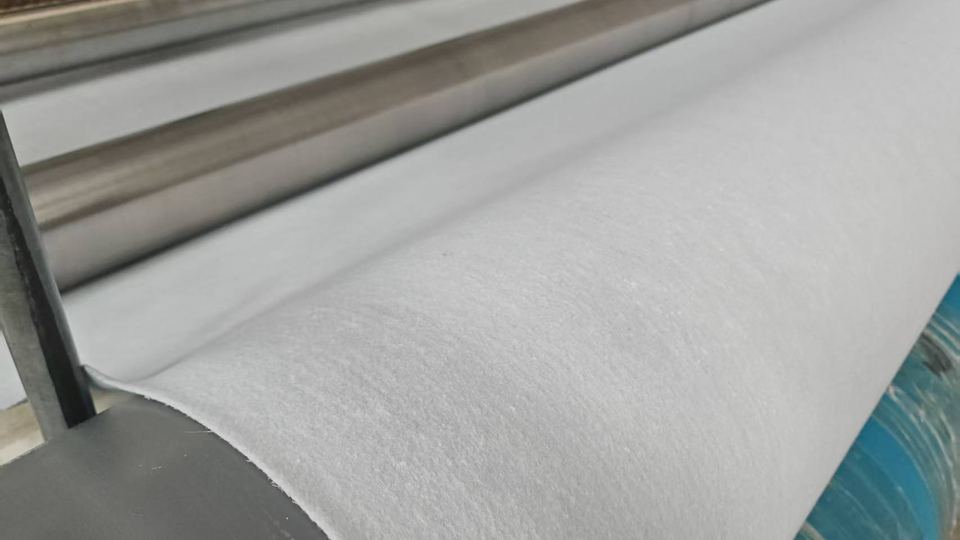
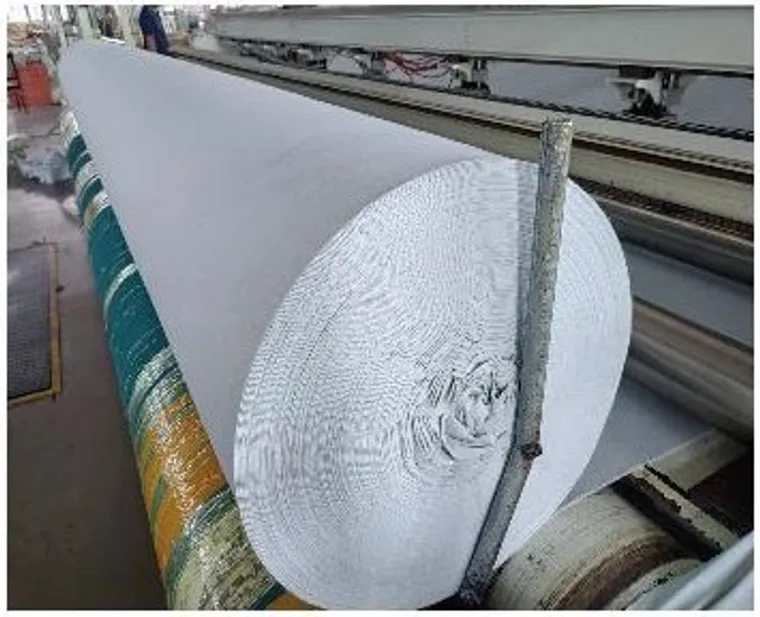
Fabric as produced
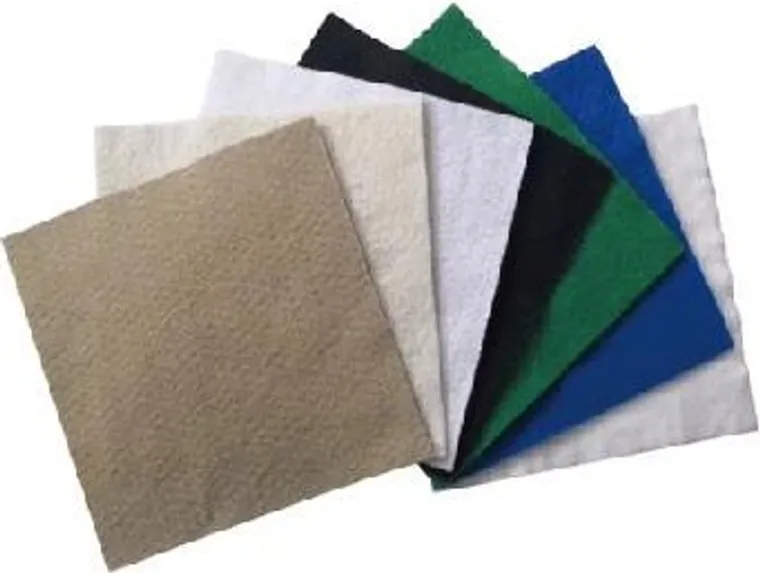
Fabric samples
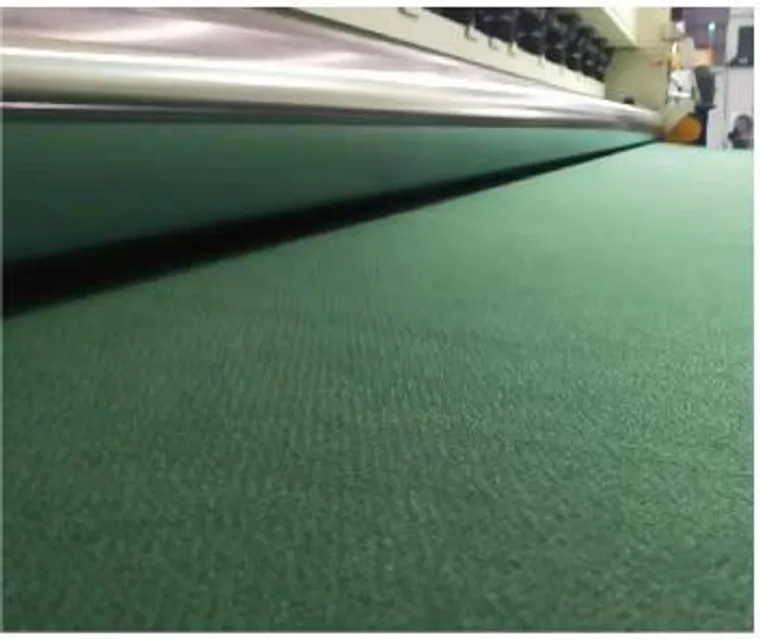
Fabric on the line
GB/T 17638 · 100–800 gsm · to 25 kN/m
Needle-punched staple fiber fabric to GB/T 17638, from 100 to 800 gsm, for separation and filtration.