How to choose a geotextile
Choosing a geotextile comes down to three questions asked in order. What the fabric has to do, because separation, filtration, drainage, and reinforcement do not call for the same properties. What strength the design needs, which sets the mass per unit area. And what the ground is like on both sides, because that sets the openings. The mass is the last thing to fix, not the first.
For the range this guide belongs to, see Geotextiles for separation, filtration and drainage.
What decides the choice
- The function, first
- Separation, filtration, drainage, and reinforcement are four different jobs, and most real applications involve more than one. The governing one sets everything else.
- The strength the design needs
- This is the figure that sets the mass per unit area. On soft ground it is usually driven by the tensile force the layer above imposes, not by the load on the finished surface.
- The openings the ground needs
- The equivalent opening size has to suit the particle sizes on both sides. A fabric that retains sand will blind on clay, and one that passes clay will not hold sand.
- How water leaves
- A geotextile passes water through its thickness and conducts it in its own plane. A specification that only considers one of those is half a specification.
- What the fabric will be exposed to
- Buried or exposed, the fiber is chosen to resist corrosion, insects, and oxidation. On a containment job the durability requirement is written into the standard.
Staple fiber and continuous filament fabric
| Property | Staple fiber, GB/T 17638 | Continuous filament, GB/T 17639 |
|---|---|---|
| Mass per unit area | 100 to 800 g/m2 | Same range, 100 to 800 g/m2 |
| Breaking strength | 2.5 to 25.0 kN/m | 4.5 to 40.0 kN/m |
| Puncture resistance | 0.3 to 4.0 kN | 0.8 to 7.0 kN |
| Tear strength | 0.08 to 0.60 kN | 0.14 to 1.10 kN |
| Opening size | O90 to O95, 0.07 to 0.2 mm | The same figures |
-
Mass per unit area
- Staple fiber, GB/T 17638
- 100 to 800 g/m2
- Continuous filament, GB/T 17639
- Same range, 100 to 800 g/m2
-
Breaking strength
- Staple fiber, GB/T 17638
- 2.5 to 25.0 kN/m
- Continuous filament, GB/T 17639
- 4.5 to 40.0 kN/m
-
Puncture resistance
- Staple fiber, GB/T 17638
- 0.3 to 4.0 kN
- Continuous filament, GB/T 17639
- 0.8 to 7.0 kN
-
Tear strength
- Staple fiber, GB/T 17638
- 0.08 to 0.60 kN
- Continuous filament, GB/T 17639
- 0.14 to 1.10 kN
-
Opening size
- Staple fiber, GB/T 17638
- O90 to O95, 0.07 to 0.2 mm
- Continuous filament, GB/T 17639
- The same figures
Geotextile or geomembrane
| Layer | What it does | Where it is used |
|---|---|---|
| Geotextile | Permeable: separates, filters, drains, reinforces | Where water has to pass and layers must not mix |
| Geomembrane | A barrier: very low permeability | Where something has to be contained rather than filtered |
-
Geotextile
- What it does
- Permeable: separates, filters, drains, reinforces
- Where it is used
- Where water has to pass and layers must not mix
-
Geomembrane
- What it does
- A barrier: very low permeability
- Where it is used
- Where something has to be contained rather than filtered
How to work through it
-
Decide the function
Work out which of the four jobs governs. Separation and filtration are usually the answer, with reinforcement added where the ground is soft.
-
Get the design strength
Ask the designer for the tensile figure the layer has to carry. That single number sets the mass per unit area, and it is the one buyers most often guess at.
-
Check the openings against the ground
Compare the equivalent opening size with the particle sizes on both sides. This is where a fabric that looks right on paper blinds in service.
-
Then pick the fabric
With those fixed, choose between staple fiber and filament on strength per unit mass. The filter behavior is the same, so the swap is a commercial decision.
Mistakes to avoid
-
Ordering by mass alone
Mass per unit area is easy to compare and it is not the specification. Two fabrics at the same weight can differ by half again in breaking strength.
-
Treating the fabric as a barrier
A geotextile is permeable by definition. Where the job needs containment, the layer is a geomembrane, and using the wrong one fails quietly.
-
Ignoring in-plane flow
Water crosses the fabric and then has to leave. A design that sizes the openings but not the drainage path leaves the water where it collected.
-
Forgetting installation damage
Most damage to a geotextile happens while it is being placed and compacted, which is also when the ground beneath it is most disturbed.
A geotextile is bought by the roll and specified by the job. The gap between those two things is where the money goes when it goes wrong.
Why mass is the wrong starting point
Mass per unit area is the figure most buyers ask for first, because it is the easiest one to compare between suppliers. It is also the least informative on its own.
Two fabrics at 200 g/m2 can be rated at 6.5 kN/m and 10.0 kN/m respectively. Ordering on mass gets you a fabric of the right weight and possibly the wrong strength, and the strength is what the design was checked against.
Why the openings do not change
Usefully, the equivalent opening size is the same across both fabrics and across the whole mass range: 0.07 to 0.2 mm. Vertical permeability is quoted the same way for both as well.
That means filtration and drainage behavior are fixed once you have chosen a geotextile at all. The remaining decisions are strength and cost, which is a much simpler conversation.
What is left to decide
Two things. Whether the design strength is reached more cheaply with staple fiber or with filament fabric, which depends on how much strength is needed and how large the area is. And the durability the site calls for, since on a containment job the standard writes an explicit retention figure for acid, oxidation, and ultraviolet exposure.
Everything else follows from the function, and the function is usually on the drawing.
Where to go next
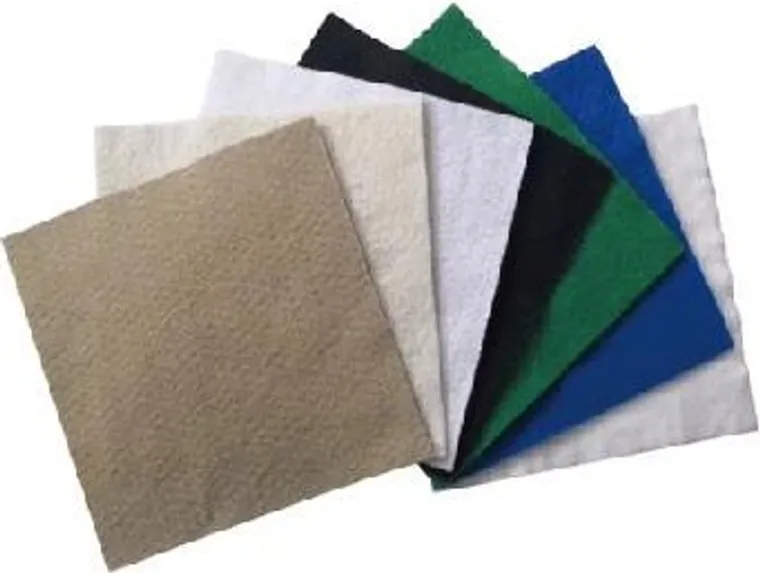
Fabric samples
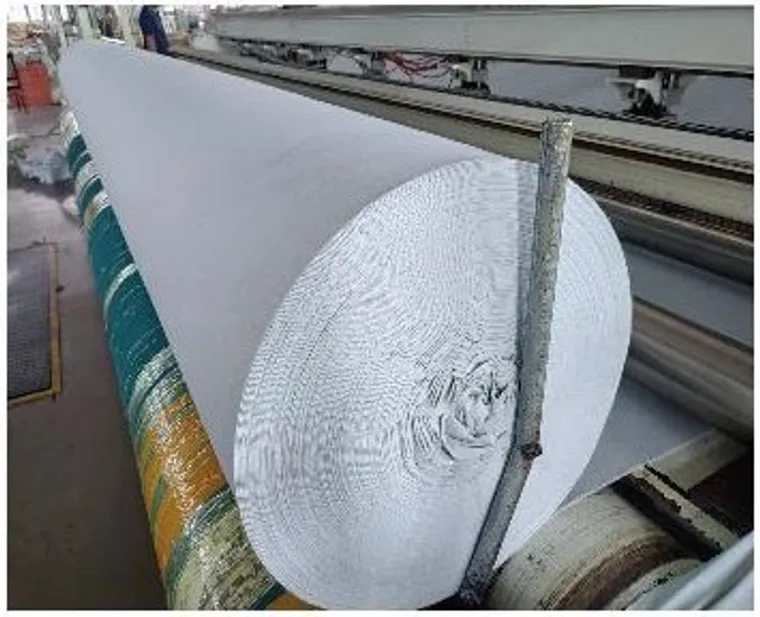
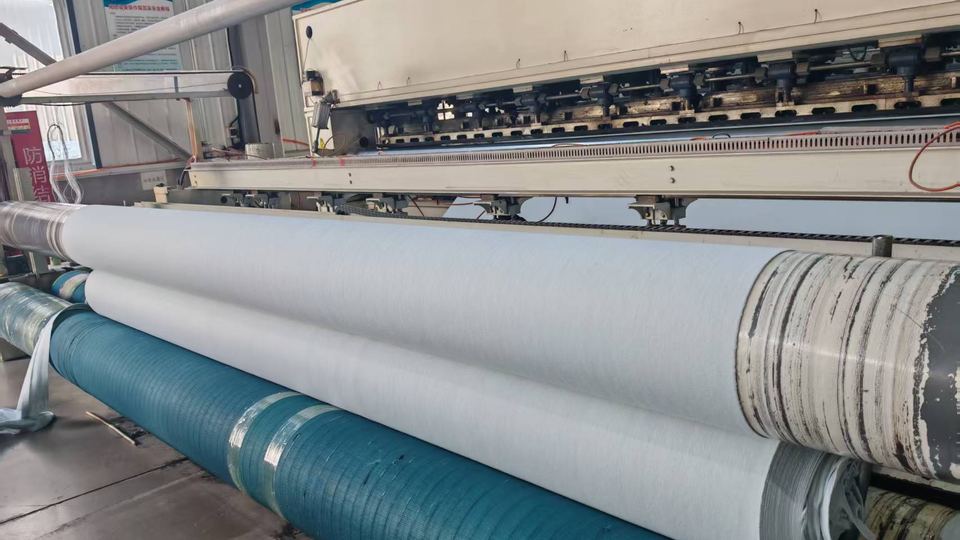
Fabric as produced