Geotextile questions and answers
Short answers to common questions about geotextiles, including the ones where the wrong answer is expensive. Each answer links to the page behind it.
For the range these answers cover, see Geotextiles for separation, filtration and drainage.
Common questions
What is geotextile used for?
Four jobs, and most real applications use more than one. It separates layers that should not mix, filters water while holding soil, drains water in its own plane, and reinforces a layer by adding tensile strength. It appears under roads, behind retaining structures, in drainage trenches, and on slopes.
What is the difference between a geotextile and a geomembrane?
Permeability. A geotextile is permeable by design: water passes through it and it filters what the water carries. A geomembrane is a barrier with very low permeability, used where something has to be contained rather than filtered. The two are often used together, with the fabric protecting the membrane.
What is the difference between staple fiber and continuous filament fabric?
Strength at a given weight. Both cover 100 to 800 g/m2. At 200 g/m2 the staple fiber fabric is rated at 6.5 kN/m and the filament fabric at 10.0 kN/m, with puncture resistance of 0.9 kN against 1.8 kN. The filter behavior is identical.
Which standard covers the fabric?
Two, and they are separate documents. Staple fiber needle-punched fabric is made to the first, which has two revisions in use. Continuous filament fabric is made to the second. If a drawing names a standard without a year, ask which revision is meant.
What is the difference between the two revisions of GB/T 17638?
What the fabric is ordered by. The earlier revision keys off mass per unit area. The later one keys off nominal breaking strength instead, from 3 to 40 kN/m, and adds durability requirements the earlier table does not carry.
What strength does the fabric carry?
It depends on the type and the mass. Staple fiber fabric runs from 2.5 to 25.0 kN/m in both directions across its range, and continuous filament fabric from 4.5 to 40.0 kN/m. Puncture resistance runs from 0.3 to 4.0 kN and 0.8 to 7.0 kN respectively.
How do I know the fabric will not clog?
The openings have to suit the particle sizes on both sides of it. Across our range the equivalent opening size is 0.07 to 0.2 mm, and it does not change with the mass per unit area, so the filter behavior is fixed once a geotextile is chosen at all.
Does the fabric let water through?
Yes, in two directions. It passes water through its thickness, and it also conducts water in its own plane, which discharges excess liquid and gas out of the soil structure. That in-plane flow is often what a drainage design actually depends on.
What is the fabric made of?
Polypropylene or polyester. Both make the fabric corrosion resistant, insect resistant, and oxidation resistant, which matters because it is usually buried and never seen again. The 2017 revision of GB/T 17638 requires at least 80% strength retention after acid, oxidation, and ultraviolet exposure.
Where is the fabric used on a road?
Between the sub-base and the ground beneath it. It stops the aggregate punching down into soft ground and stops the fines migrating up into the voids, while letting water through instead of trapping it under the road. The tensile strength it adds is often what lets the specified thickness be built.
Can the fabric be used on a slope?
Yes, as surface protection. It holds the soil while water passes, which stops the first rill from forming and growing into a channel, and it adds tensile strength to the surface layer until vegetation establishes. It does not retain a slope structurally.
What do you need to quote the fabric?
Three things: the mass per unit area or the design strength, the roll width and total area, and the destination port. If your drawing names a standard, say which revision, because GB/T 17638 has two in use and they key off different properties.
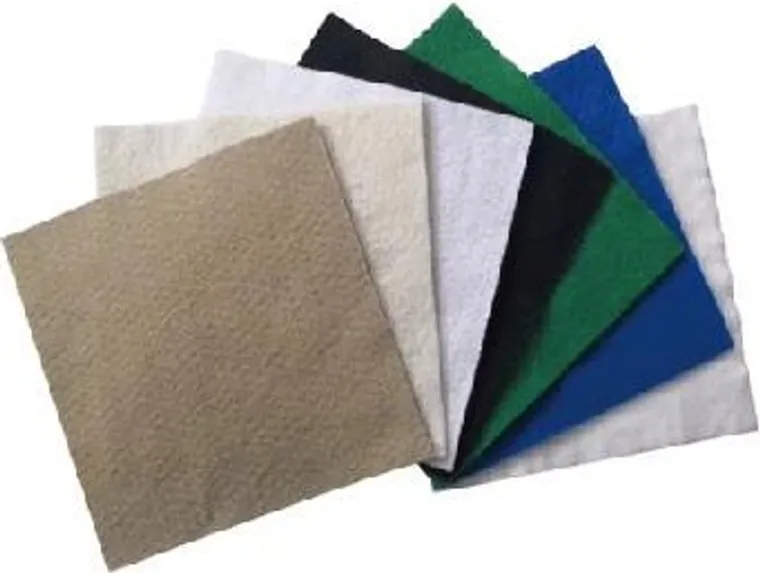
Fabric samples
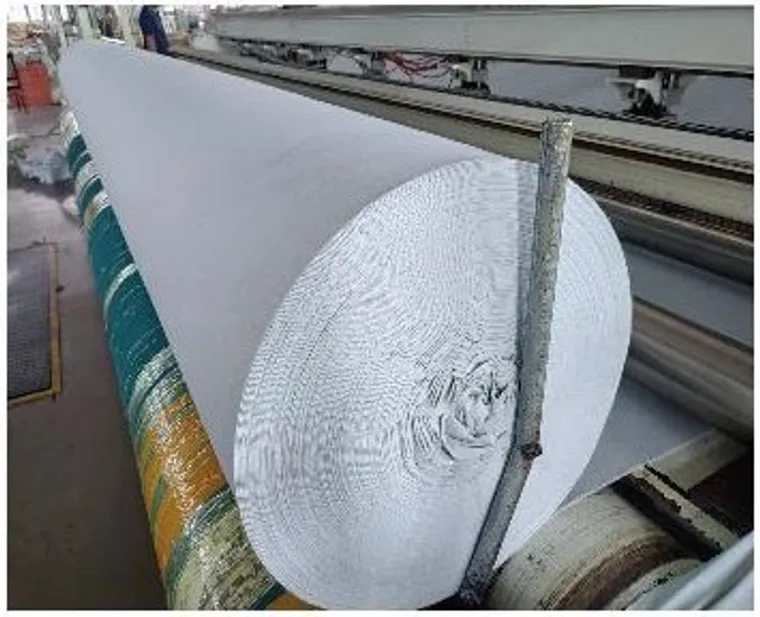
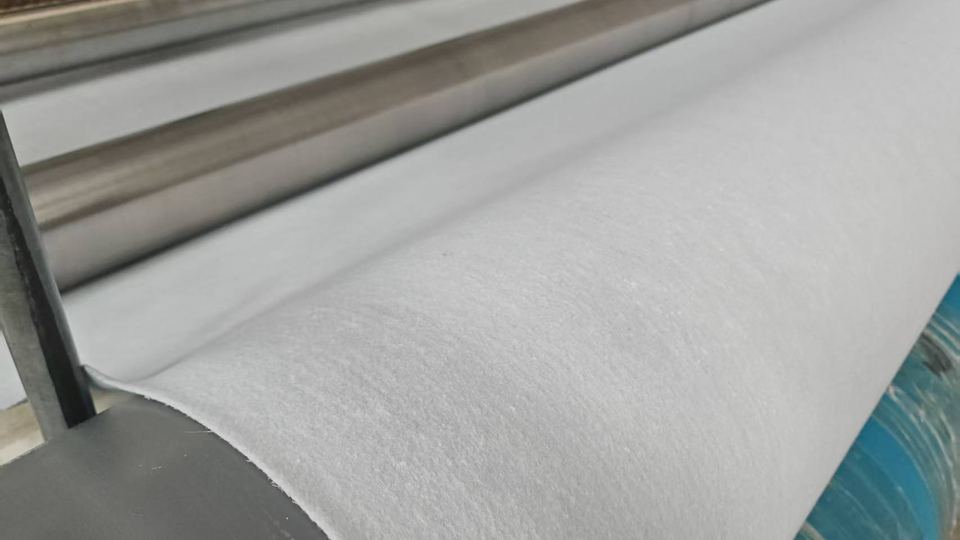
Fabric as produced