Drainage board questions and answers
Short answers to common questions about drainage boards, with the published figures where they exist and a link to the page behind each one.
For the range these answers cover, see Drainage boards for roofs, walls and subgrades.
Common questions
What is a dimpled drainage board?
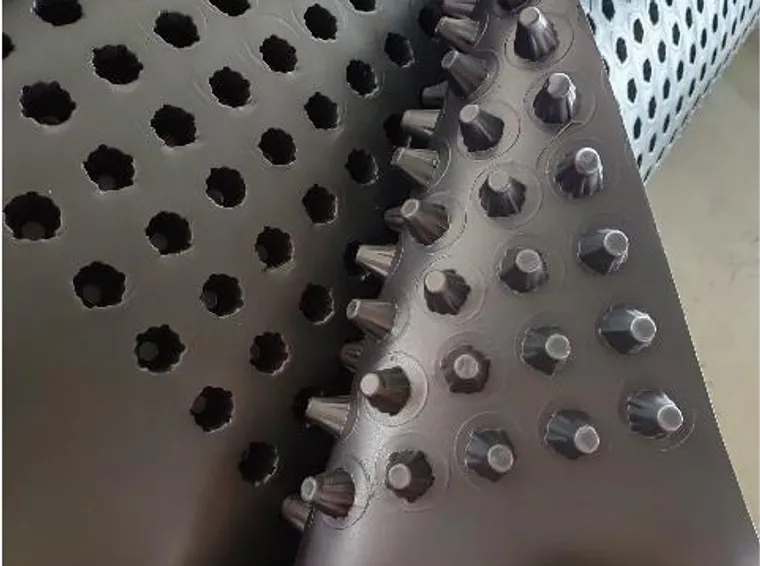
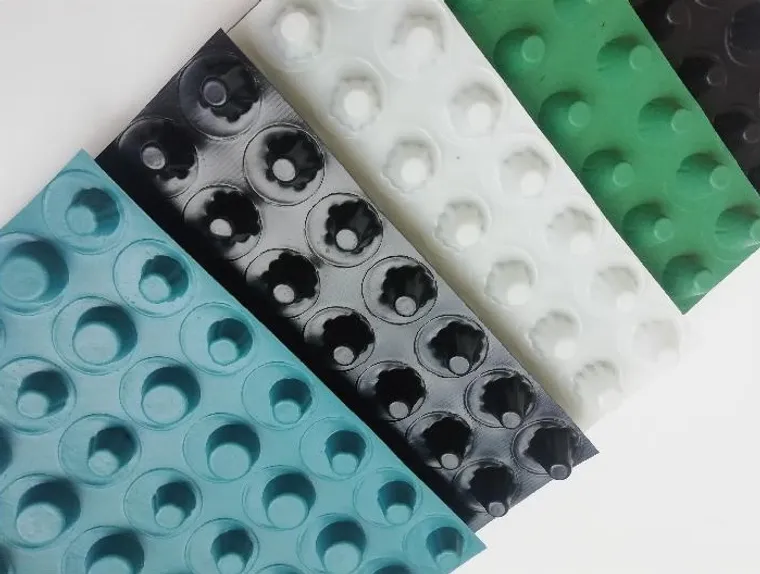
It is an HDPE sheet formed into a pattern of cups. The cups hold the layers above it apart, and the gap between them is the path water travels along. On the board we supply, a mesh and a non-woven fabric are laminated onto the dimpled face, so the same layer filters and drains. It replaces a granular drainage layer at a fraction of the weight.
What size does a drainage board come in?
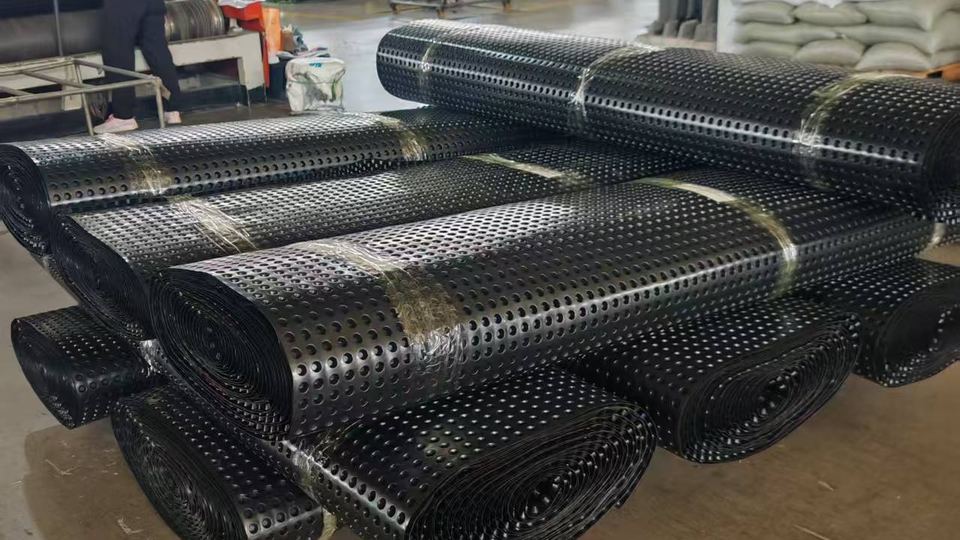
It comes in rolls, made on our own extrusion lines. Typical for this class of board is a roll of about 2 m by 30 m with a dimple height of about 4 mm, though both are set by the job. Confirm the roll size and dimple height against your specification before ordering.
How much water can a drainage board carry?
Typical drainage capacity for this class of board is about 0.6 liters per second per square meter, and the figure is per square meter of board, so the area being drained sets how much of it you need. Capacity moves with dimple height and with the fall on the board, so treat it as indicative and confirm it against your specification. It also assumes the outlet can take the flow, which is the part most often left to site.
What load can a drainage board take?
Our storage and drainage board is specified for over 400 kPa. The exact figure matters less than what it is measured against, because the board has to hold its voids while the layers above are placed and compacted.
What do you need to quote a drainage board?
Four things: the area being drained, what sits above the board and how heavy that layer is when saturated, the roll size and dimple height you need, and the destination port. If your specification names a standard, send it too, and we will quote against that rather than against a generic board.
What is the difference between a drainage board and a storage board?
A drainage board drains only. A storage and drainage board does both: its cups are deeper, so it holds a volume of water in the void and releases it slowly. That stored volume is what carries planting through a dry spell. Choose by asking whether the job needs water held back at all.
Where is a drainage board used?
Retaining walls, basements, tunnels, slope protection, platforms, and highway roadbeds. The board is also used on garage roof and plaza greening where the soil layer is deep and no water storage is needed. Those are the cases where drainage alone is the requirement.
What does a double-sided board add?
It holds the slab and the layers above apart on both faces. One board then drains, insulates against moisture, keeps heat in, and separates roots. It is usually made of HIPS or HDPE, and it is the choice where the build-up height above a buried deck is fixed.
How do the rolls or panels join?
The edges carry supports of two sizes, so one panel overlaps the next down the slope. Overlapping in that direction keeps the seepage path continuous to the outlet. It is what stops water collecting in a low spot between two panels instead of reaching the drain.
Does the board need a filter layer?
On the board we supply, no. The mesh and non-woven fabric are already laminated onto the dimpled face, so the board filters as well as drains. That removes a separate separation layer from the build-up, which matters where the build-up height is the constraint on the design.
How long does a drainage board last?
The board is HDPE, and it resists long-term pressure without deforming. That is what keeps the original drainage volume over the life of the structure. A service life of 50 years is the order of magnitude to expect for this class of board, though it depends on the load and the ground conditions, so confirm it for your project.
Why does a retaining wall need drainage?
The wall is designed for the soil behind it, and water held in that soil is a second load. A board down the back of the wall gives that water a path to the base, where a footing drain takes it away. Designing the board without the drain only moves the problem down.
Board face
Board samples