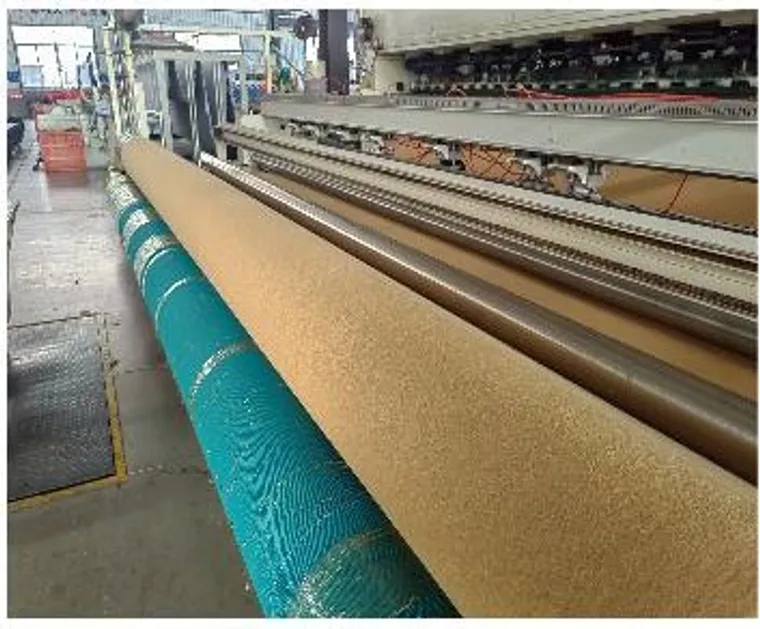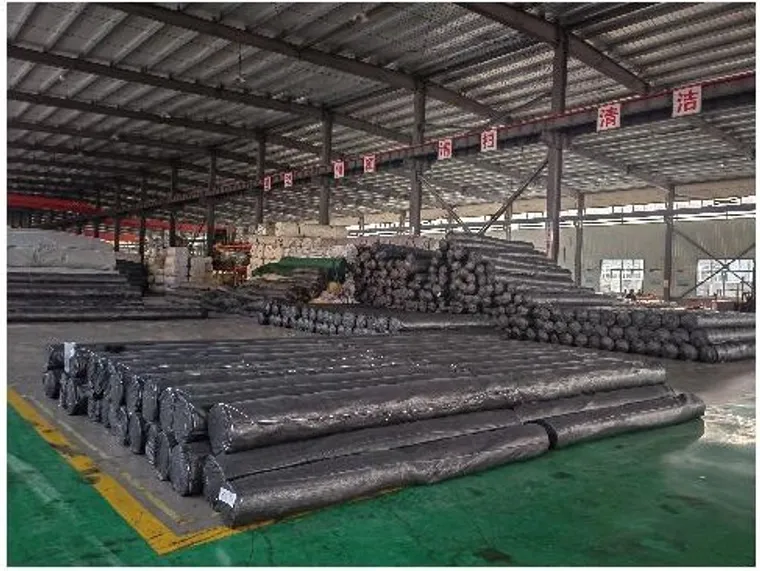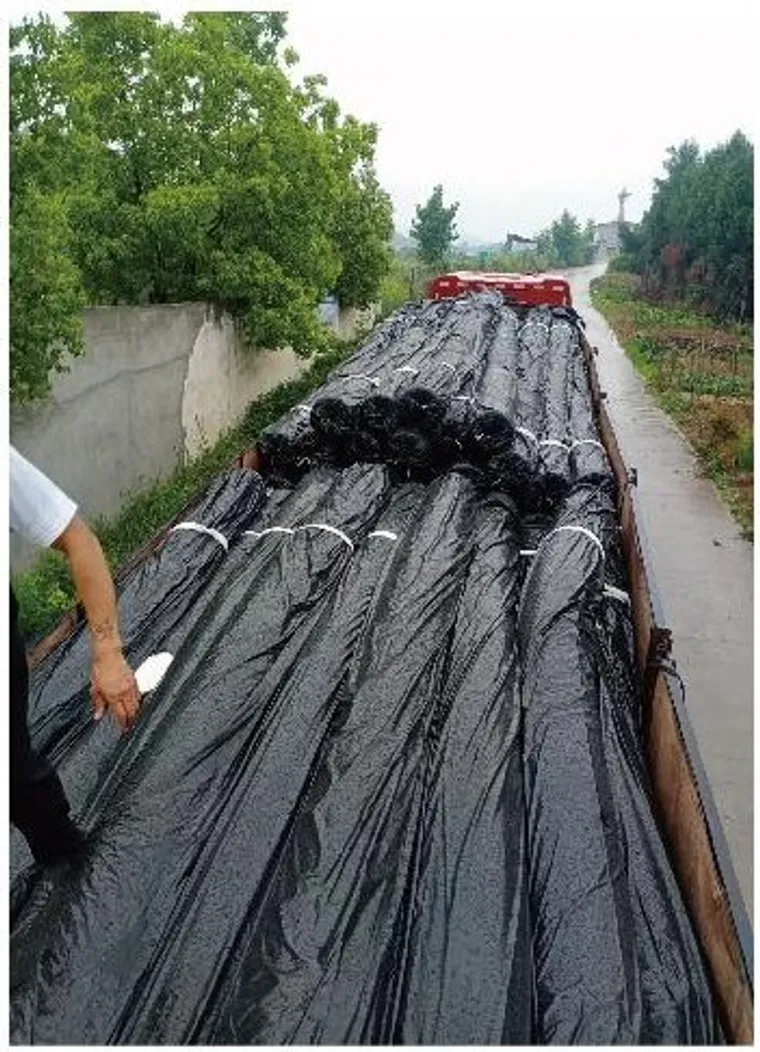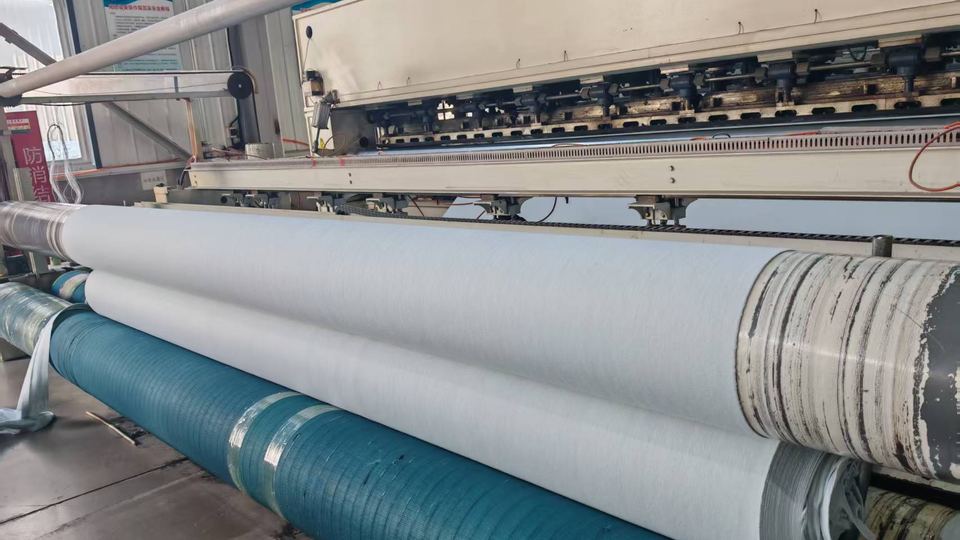
Continuous filament geotextile
The continuous filament geotextile is made to GB/T 17639 in the same 100 to 800 g/m2 range as the staple fiber fabric, but it carries more strength at the same weight. Breaking strength runs from 4.5 to 40.0 kN/m and puncture resistance from 0.8 to 7.0 kN. That is the reason to choose it: the design strength is reached with less material.
Continuous filament geotextile specification
| Property | Value |
|---|---|
| Standard | GB/T 17639 |
| Mass per unit area | 100–800 g/m2 |
| Thickness | 0.8–5.5 mm |
| Breaking strength | 4.5–40.0 kN/m, both directions |
| Elongation at break | 40–80% |
| CBR puncture resistance | 0.8–7.0 kN |
| Tear strength | 0.14–1.10 kN |
| Opening size | O90 to O95, 0.07–0.2 mm |
| Vertical permeability | K x (10-1 to 10-3) cm/s |
| Fiber | Polypropylene or polyester |
-
Standard
- Value
- GB/T 17639
-
Mass per unit area
- Value
- 100–800 g/m2
-
Thickness
- Value
- 0.8–5.5 mm
-
Breaking strength
- Value
- 4.5–40.0 kN/m, both directions
-
Elongation at break
- Value
- 40–80%
Show all 10 rows
-
CBR puncture resistance
- Value
- 0.8–7.0 kN
-
Tear strength
- Value
- 0.14–1.10 kN
-
Opening size
- Value
- O90 to O95, 0.07–0.2 mm
-
Vertical permeability
- Value
- K x (10-1 to 10-3) cm/s
-
Fiber
- Value
- Polypropylene or polyester
What defines this product
More strength per kilogram
At the same mass per unit area the filament fabric carries a higher breaking strength and a higher puncture resistance than the staple fiber fabric.
Built for reinforcement
It adds tensile strength and resistance to deformation, which is what stabilizes the structure above it.
Filters and drains
It intercepts fines while water passes, and conducts water in its own plane out of the soil structure.
Keeps layers apart
It stops sand, gravel, soil, and concrete above and below it from mixing.
Weight you do not pay to move
It is light, easy to handle, and simple to install, which matters on a large area.
Where it is used
-
Reinforced sub-base
Where the design needs tensile strength in the ground, the filament fabric reaches it at a lower mass.
-
Embankments and slopes
Holding the soil while letting water out of it, on ground that has to stay stable.
-
Landfill and containment protection
A filter and a cushion layer where a barrier sits underneath it.
The continuous filament fabric and the staple fiber fabric cover the same mass range and do the same four jobs. The difference is how much strength each one carries at a given weight, and that is a commercial question as much as a technical one.
The comparison that decides it
Read the two tables at the same mass per unit area. At 200 g/m2 the staple fiber fabric is rated at 6.5 kN/m and the filament fabric at 10.0 kN/m, with puncture resistance of 0.9 kN against 1.8 kN.
Same weight. Roughly half again the strength. On a job that is specified by strength rather than by mass, that means the design point is reached with a lighter fabric, and the saving carries through the whole order.
Where that matters most
On a large area the difference compounds. A sub-base over soft ground is measured in hectares, and the mass per square meter is the number that gets multiplied.
It also matters where the fabric has to be handled. A lighter roll is easier to carry, quicker to lay, and less punishing on the ground underneath it while it is being laid.
What stays the same
Everything about the filter behavior. Both fabrics have an equivalent opening size of 0.07 to 0.2 mm, and both are quoted at the same vertical permeability. Changing from one to the other does not change how the fabric filters or drains.
That is worth knowing, because it means the swap can be made on strength grounds alone, without reopening the filtration design.
Fabric on the line
Rolls in store
Rolls delivered