Water storage module questions and answers
Short answers to the questions buyers ask most about water storage modules, including the awkward ones, each linking to the page behind it.
For the range these answers cover, see Rainwater storage systems, built underground.
Common questions
What is a water storage module?
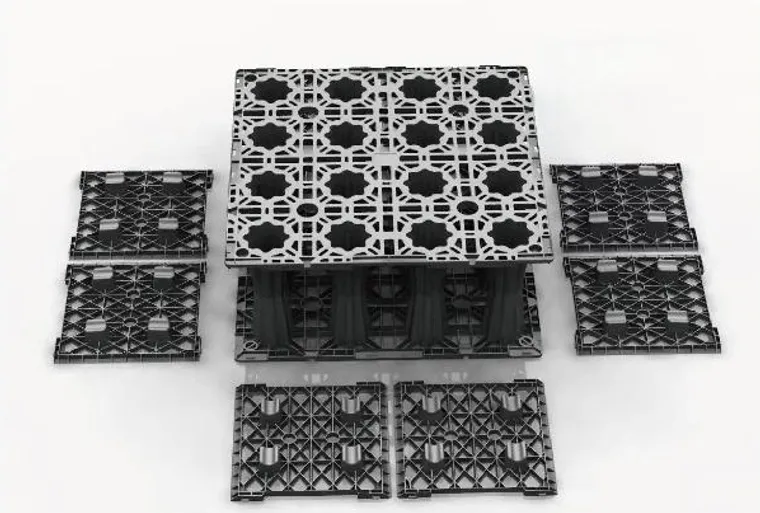
It is a polypropylene block that stacks with the blocks around it to form an underground tank. Most of the block is void, and that void is the storage volume. A geocellular system is generally defined this way: there is no vessel, and the water is held in the gap between the plastic.
How much water does one module hold?
The storage volume is the void inside the block, and about 95% of our module is hollow. That is the figure to use when working out how many blocks a tank needs, because the capacity comes from the block rather than from a separate chamber.
What is the module made of?
It is molded from regenerated polypropylene. The material does not precipitate anything into the water after immersion, has no odor, and resists strong acid and alkali. Those properties matter most in a harvesting tank, where water is held for weeks in contact with the module.
Does the tank need a geotextile wrap?
It needs a wrap, and which one depends on the duty. A geotextile lets water out into the surrounding ground, which is what infiltration needs. A waterproof cloth makes the tank hold water, which is what attenuation and harvesting need. The same block serves all three.
Can it go under a car park or an access road?
Generally yes, provided the structural performance has been shown to be adequate for that loading. That is the usual reason for choosing a buried tank: the surface carries on working. Tell us what will be above the tank, because the modules are specified against that load.
Does a storage module treat the water?
No, and this is worth knowing before the design is fixed. Independent guidance is clear that a geocellular system generally provides no water quality treatment of its own. Where treatment is required it has to be a separate stage ahead of the tank, sized for what it will catch.
What are the downsides?
Three, and they are all about what happens after the tank is buried. It provides no water quality treatment of its own, its performance is difficult to monitor, and it can be difficult to maintain. None of that rules it out, but each one has to be answered in the design.
How do you maintain a buried tank?
Maintenance generally means regularly inspecting silt traps, manholes, pipework, and any pre-treatment device, and removing sediment and debris as needed. Every one of those has to be reachable, which is why the access is designed at the same time as the tank.
How is the tank assembled?
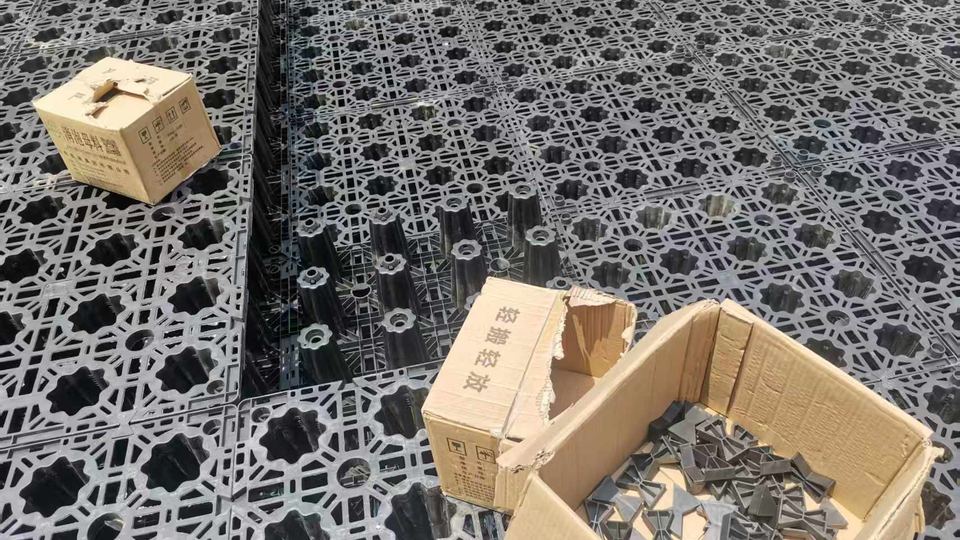
The modules are stacked on site where the tank will sit. That shortens the program compared with lifting a completed chamber into a hole, and it lets the tank follow the shape of the excavation rather than the excavation being dug to fit the tank.
How long does a water storage module last?
Our module has a service life of more than 40 years, and guidance generally expects geocellular systems to remain physically and chemically stable over the long term. The figure matters because the tank is buried. Replacing it means digging the surface up again.
What is the difference between attenuation and harvesting?
Attenuation holds water back and releases it at a controlled rate, so nothing is kept. Harvesting keeps the water and draws it off for reuse. Both are built from the same modules, and the wrap and the outlet are what separate them.
What do you need to quote a storage tank?
Four things: the volume to be stored, the depth available, what the surface above the tank will carry, and whether the tank attenuates, harvests, or infiltrates. The duty sets the wrap, and the wrap is part of the quotation rather than an extra.
Sources
General industry background in these answers draws on the sources below. Product data comes from the manufacturer's product literature.
Single module
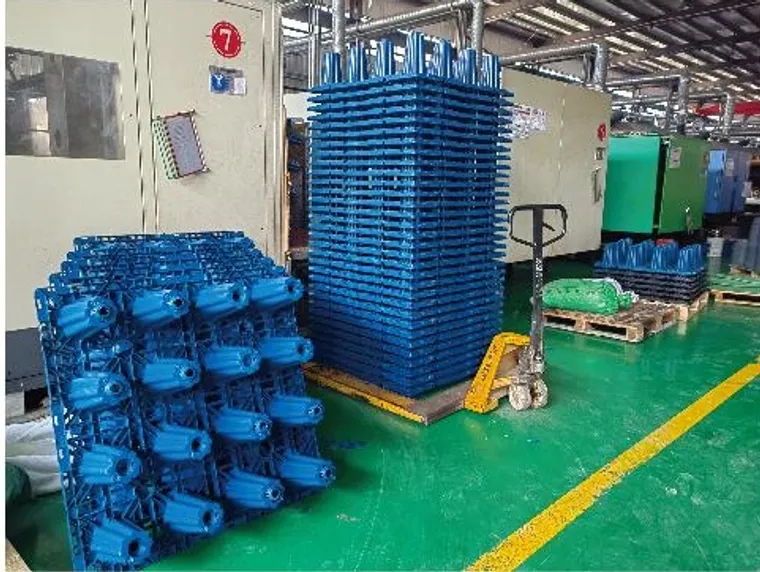
Modules as molded