How to choose a geomembrane liner
A geomembrane is chosen in two stages, and buyers often only do the first. The first stage is the sheet: what it is made of, how thick it is, and what the standard says about it. The second stage is the system around it, which is where most lining failures actually come from. A sheet that passes every test can still leak through a weld, a puncture, or a detail nobody designed.
For the range this guide belongs to, see Geomembranes for containment and lining.
What decides the choice
- What has to be kept apart
- The duty decides the material. Containing leachate, holding process solution, and stopping seepage in a reservoir are three different chemical and mechanical problems.
- What the sheet will meet
- Chemical compatibility between the liner and what it will contain is typically assessed before the liner is selected. Where the stream is unusual, that assessment decides the material.
- What protects it
- A geomembrane is typically protected against puncture, ultraviolet degradation, and localized stress. Geotextiles and fine mineral layers are both generally used for it.
- How the joints will be tested
- Panels are generally welded. Seams are generally checked by non-destructive testing along their length and by destructive testing of cut samples.
- Who installs it
- Installation is generally carried out by trained personnel, with welders holding an accredited welding qualification. On a lining job that is the cheapest assurance available.
The sheet, and the system around it
| Part | What it does | Who decides it |
|---|---|---|
| The geomembrane | The barrier: a flexible polymeric sheet with very low permeability | The specifier, from the duty and the chemistry |
| The composite base | A compacted clay layer paired with the membrane as backup and bedding | The designer, from the regulatory requirement and the ground |
| The protection layer | Stops puncture, UV degradation, and localized stress reaching the sheet | The designer, from what is placed on top and how heavy it is |
| The collection system | Carries the contained liquid away above the liner for treatment | The designer, and it has to be reachable |
| The installation | Welding, testing, and the survey that confirms the seams hold | The installer, working to the specifier testing regime |
-
The geomembrane
- What it does
- The barrier: a flexible polymeric sheet with very low permeability
- Who decides it
- The specifier, from the duty and the chemistry
-
The composite base
- What it does
- A compacted clay layer paired with the membrane as backup and bedding
- Who decides it
- The designer, from the regulatory requirement and the ground
-
The protection layer
- What it does
- Stops puncture, UV degradation, and localized stress reaching the sheet
- Who decides it
- The designer, from what is placed on top and how heavy it is
-
The collection system
- What it does
- Carries the contained liquid away above the liner for treatment
- Who decides it
- The designer, and it has to be reachable
-
The installation
- What it does
- Welding, testing, and the survey that confirms the seams hold
- Who decides it
- The installer, working to the specifier testing regime
Where the risk actually sits
| Stage | What is done | Why it matters |
|---|---|---|
| Before work starts | Trial seams at the start of work and of each shift | Confirms the welding equipment suits the sheet and the weather |
| While laying | No machine or truck tracks directly on the membrane | The membrane is more susceptible to damage during installation than in service |
| While welding | Welds run down a slope or sit on a flat base, and are kept to a minimum | Fewer joints means less testing and fewer places to leak |
| After the layers go on | A geophysical leak location survey over the membrane | It is the last chance to find a defect before the cell is used |
-
Before work starts
- What is done
- Trial seams at the start of work and of each shift
- Why it matters
- Confirms the welding equipment suits the sheet and the weather
-
While laying
- What is done
- No machine or truck tracks directly on the membrane
- Why it matters
- The membrane is more susceptible to damage during installation than in service
-
While welding
- What is done
- Welds run down a slope or sit on a flat base, and are kept to a minimum
- Why it matters
- Fewer joints means less testing and fewer places to leak
-
After the layers go on
- What is done
- A geophysical leak location survey over the membrane
- Why it matters
- It is the last chance to find a defect before the cell is used
How to work through it
-
Fix the duty
Decide what has to be kept apart from what. Containment, recovery, and seepage control lead to different materials and different build-ups.
-
Check the chemistry before the price
Chemical compatibility is typically assessed before the liner is selected. A cheaper sheet that the stream attacks is not cheaper.
-
Design the protection and the base
The subgrade has to be free of sharp steps and large irregularities, and something has to sit between the membrane and whatever comes next.
-
Write the testing into the contract
Trial seams, non-destructive seam testing, destructive samples, and a leak location survey. If they are not in the specification they will not happen.
Mistakes to avoid
-
Choosing the sheet and leaving the system
The membrane is one layer in a build-up that includes a base, a protection layer, and a collection system. Specifying only the sheet leaves the rest to whoever gets there first.
-
Treating thickness as the only variable
Thickness is easy to compare and it is not the whole specification. Oxidative induction time, carbon black dispersion, and stress crack resistance come from the compound, not the gauge.
-
Forgetting the plant on site
Guidance is explicit that no machine or truck may track directly on a geomembrane once placed. On a busy site that rule needs to be in the method statement.
-
Skipping the survey
A leak location survey is typically run after the layers above the membrane go on. It is the last point at which a defect can be found cheaply.
A lining job is bought as a sheet and paid for as a system. The gap between those two things is where the money goes when it goes wrong.
Thickness is the easy question
Thickness is the first thing every buyer asks about, because it is the easiest number to compare. It is also the least informative on its own.
Two sheets of the same gauge can behave differently in service, because what determines how a geomembrane ages is the compound rather than the gauge. Carbon black content and dispersion, oxidative induction time, and stress crack resistance are all properties a standard specification tests for, and all of them come from how the resin was formulated.
The joints are the risk
Geomembranes resist seepage well. The failures that happen tend to be at the seams, or at the points where the sheet was damaged before it was covered.
That is why the testing regime is not paperwork. Trial seams confirm the equipment suits the sheet. Non-destructive testing checks the length of every seam. Destructive testing on cut samples confirms what the non-destructive testing implies. The leak location survey catches what all of it missed.
The rule that is most often broken
UK Environment Agency guidance on landfill engineering states that no machine or truck may track directly on a geomembrane once it has been placed. It is a simple rule and it is broken constantly, because sites are busy and the alternative is a longer route.
The same guidance notes that geomembranes are considerably more susceptible to damage during installation than in service. Put those two statements together and the conclusion is uncomfortable: most of the damage a liner will ever suffer happens before it is asked to do anything.
Where to go next
Sources
General industry background on this page draws on the sources below. Product data comes from the manufacturer's product literature.
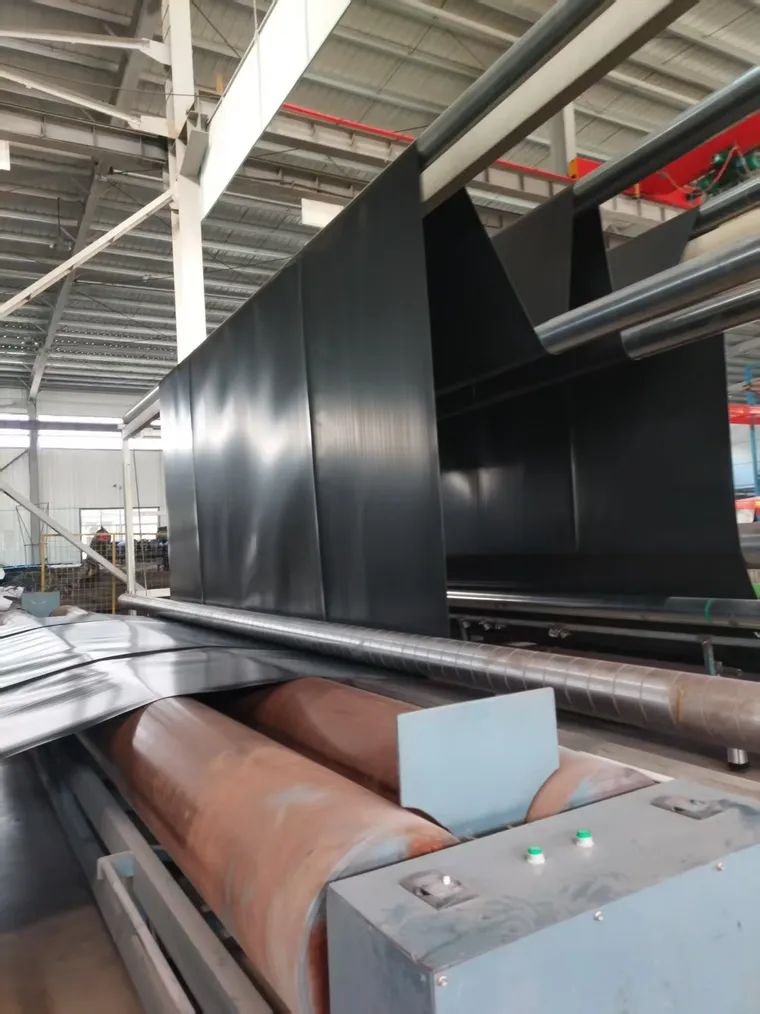
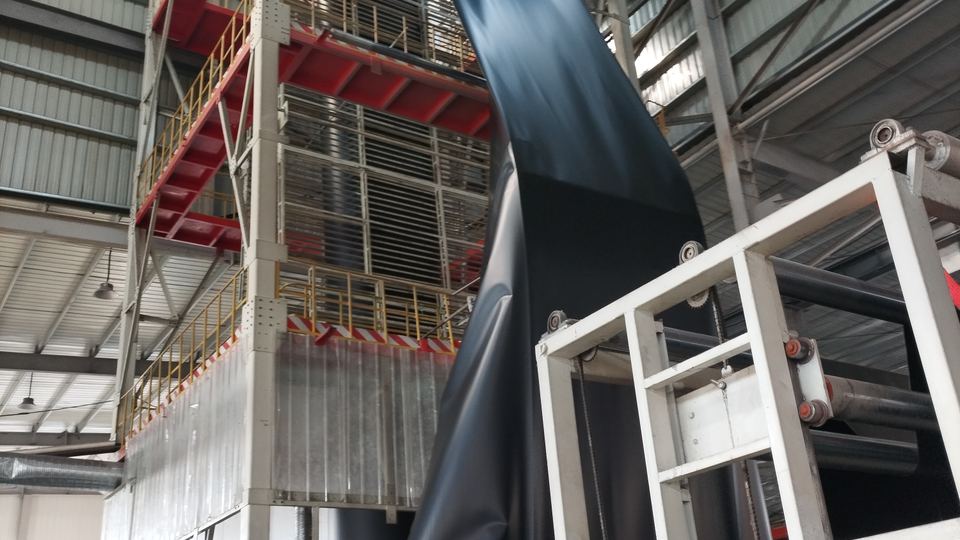
HDPE sheet as supplied
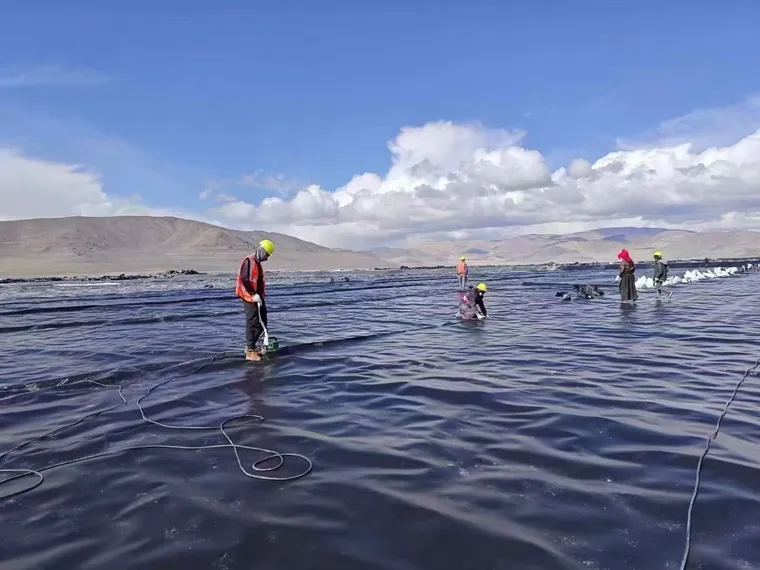
Panels being laid across a reservoir