PP · mostly void · over 40 years
Rainwater Storage Module
A polypropylene block that is mostly void, stacked on site into an underground tank for attenuation, harvesting or infiltration.
 Wanlihe
 Products
Applications
Guides
FAQ
Products
Applications
Guides
Standards
FAQ
Products
Applications
Guides
FAQ
Infiltration is the option that looks simplest and is decided furthest from the drawing board, because it depends on the ground. A soakaway only works if the soil beneath it will accept water at the rate the site produces it, and if the water table and the bedrock leave enough room. Where those conditions hold, infiltration sends runoff back where it came from instead of down a drain, and it is usually the cheapest way to deal with surface water on a site that has nowhere to discharge it.
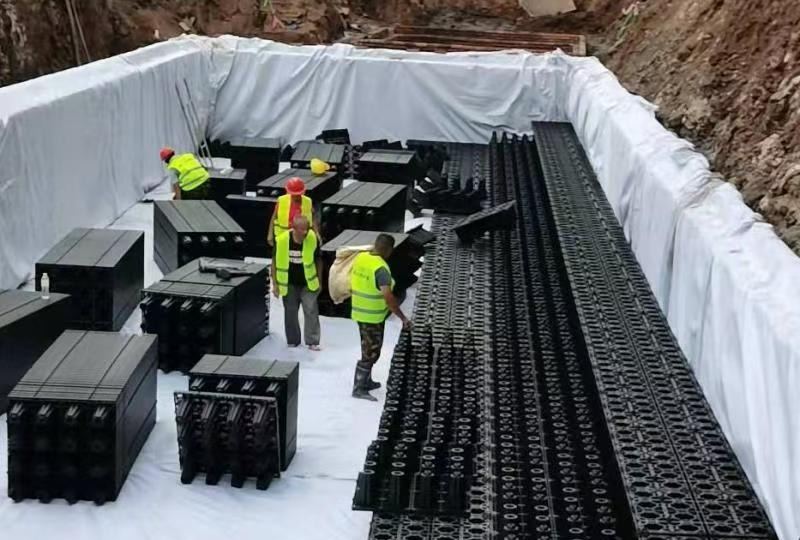
Infiltration and soakaway systems are built from the same units as a storage tank. What separates them is the wrap and the connections. A tank is wrapped in an impermeable membrane so the water stays in. A soakaway is wrapped in a geotextile so the water passes out into the surrounding ground.
That distinction decides how the whole design is checked. A tank is sized on the volume it has to hold. A soakaway is sized on the rate the ground will accept, which is a property of the site rather than of the product.
A soakaway is only as good as the soil around it. The design starts with a percolation test, and the test result sets how much ground area the system needs. A storm the system cannot discharge fills it and leaves it full, and a full soakaway behaves like a blocked one.
Guidance rates geocellular systems well on peak flow reduction either way. On volume reduction the rating depends on infiltration: where water soaks away the system reduces the volume reaching the drain, and where the system only stores it does not. That is the practical difference between this page and attenuation, and it is worth being clear about which one the site actually needs.
Whatever soaks away also enters the groundwater, so what the runoff carries matters. A geocellular system provides no water quality treatment of its own. Where the runoff comes off a roof or a clean hardstanding that is usually acceptable, and where it comes off a yard or a road it usually is not without a treatment stage ahead of it.
The treatment stage has to be a separate component, sized for the sediment it will catch, and it has to be reachable. None of that can be added once the surface above is back in use.
Because the units are modular, the system can generally be shaped to fit the excavation rather than the excavation being dug to suit the product. They are lightweight and straightforward to install, and the finished system is robust once it is in place.
They can generally be installed under trafficked or non-trafficked ground, including public open space and areas used for play, provided the structural performance has been shown to be adequate for the loading. Burying the system under the surface that produces the runoff is usually the whole reason the site can afford the land for it.
Guidance is honest that a buried system is difficult to monitor once the surface above is back in use, and difficult to maintain for the same reason. That does not make it the wrong choice. It makes the access provision the part of the design that decides whether the soakaway still works in ten years.
Maintenance generally means regularly inspecting silt traps, manholes, pipework, and any pre-treatment device, and clearing sediment as needed. Every one of those needs to be reachable from the surface, and none of them can be added later.
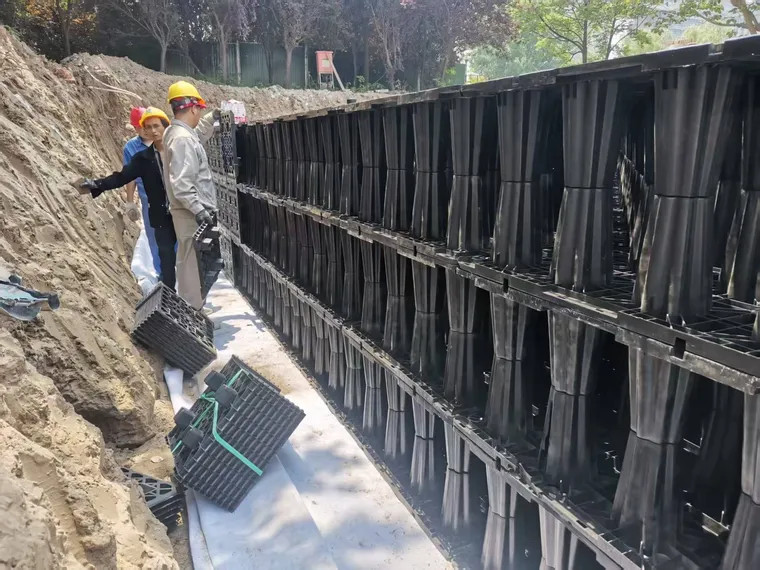
Modules stacked against the excavation
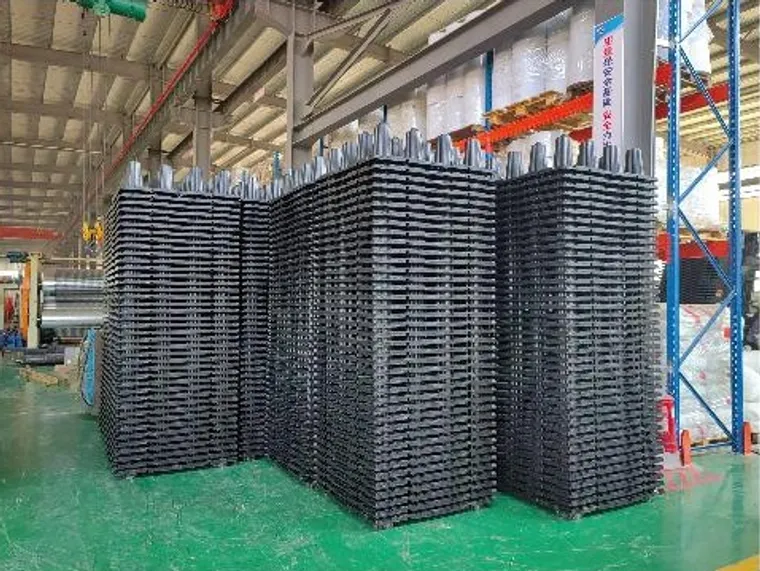
Modules in stock
PP · mostly void · over 40 years
A polypropylene block that is mostly void, stacked on site into an underground tank for attenuation, harvesting or infiltration.