Geomembrane questions and answers
Short answers on geomembranes and lining systems, including what thickness geomembrane for a landfill, each linking to the fuller page.
For the range these answers cover, see Geomembranes for containment and lining.
Common questions
What is a geomembrane?
It is a flexible polymeric sheet with very low permeability, used to stop something moving from one place to another. Panels are typically joined by welding. What it contains varies: leachate in a landfill, process solution on a mine, or simply water in a reservoir.
What thickness do I need?
It depends on the duty rather than on a default. The sheet has to resist puncture, chemical attack, and the loads placed on it, and a protection layer is generally what stops those reaching the membrane. Our range runs from 0.25 mm to 3.0 mm, and the right point in it follows from the build-up.
Why do you say part of your range is outside GRI-GM13?
Because it is, and it is better to say so. GRI-GM13 applies to HDPE geomembranes at a formulated sheet density of 0.940 g/cc or higher, and its thickness scope starts at 0.75 mm. Our range runs from 0.25 mm, so the thinner sheets sit below where the specification begins.
How are the seams tested?
In three ways. Trial seams are made before work starts and at the beginning of each shift. Seams are then checked by non-destructive testing along their length, and by destructive testing of cut samples. Finally a geophysical leak location survey is run after the protection and drainage layers are placed.
Where do lining jobs actually fail?
Rarely in the sheet. Geomembranes resist seepage well and are considerably more susceptible to damage during installation than in service. Most of the damage a liner suffers happens before it is asked to contain anything, which is why the installation rules matter more than the datasheet.
Can plant drive on the liner?
No. UK Environment Agency guidance on landfill engineering states that no machine or truck may track directly on a geomembrane once it has been placed. The rule exists because the consequences are invisible at the time and expensive later.
What has to be under the membrane?
A prepared base. Guidance asks for a subgrade free of sharp steps and large irregularities, and gives a maximum particle size for the material in contact with an HDPE membrane. A liner laid on a rough base is a puncture waiting for the load that will cause it.
What protects the membrane?
A designed protection layer, not a precaution. Geotextiles and fine-grained mineral layers are both generally used, and guidance gives typical thicknesses for each. Which one is right depends on what is placed on top and how heavy it is.
Why does a landfill need a liner?
Because leachate generally forms when rainfall percolates through waste and draws chemical constituents out of it. The liner keeps that liquid away from the groundwater and soil beneath the cell, and a collection system above it carries the liquid away for treatment.
What is a composite liner?
A composite liner typically pairs a geomembrane with a compacted clay layer to line the base and sides of a containment cell. The membrane is the barrier and the clay is both the backup and the bedding it sits on.
Does the liner need to suit what it contains?
Yes, and that is assessed before selection rather than after. Chemical compatibility between the liner material and the waste, leachate, or gas it will meet is typically checked first. Where the stream is unusual, that assessment decides the material rather than the price.
What should I ask a supplier for?
Three documents, and they are all about installation rather than the sheet. The welders qualification records, the trial seam results, and the leak location survey report. Those tell you more about whether the lining will hold than any datasheet does.
Sources
General industry background in these answers draws on the sources below. Product data comes from the manufacturer's product literature.
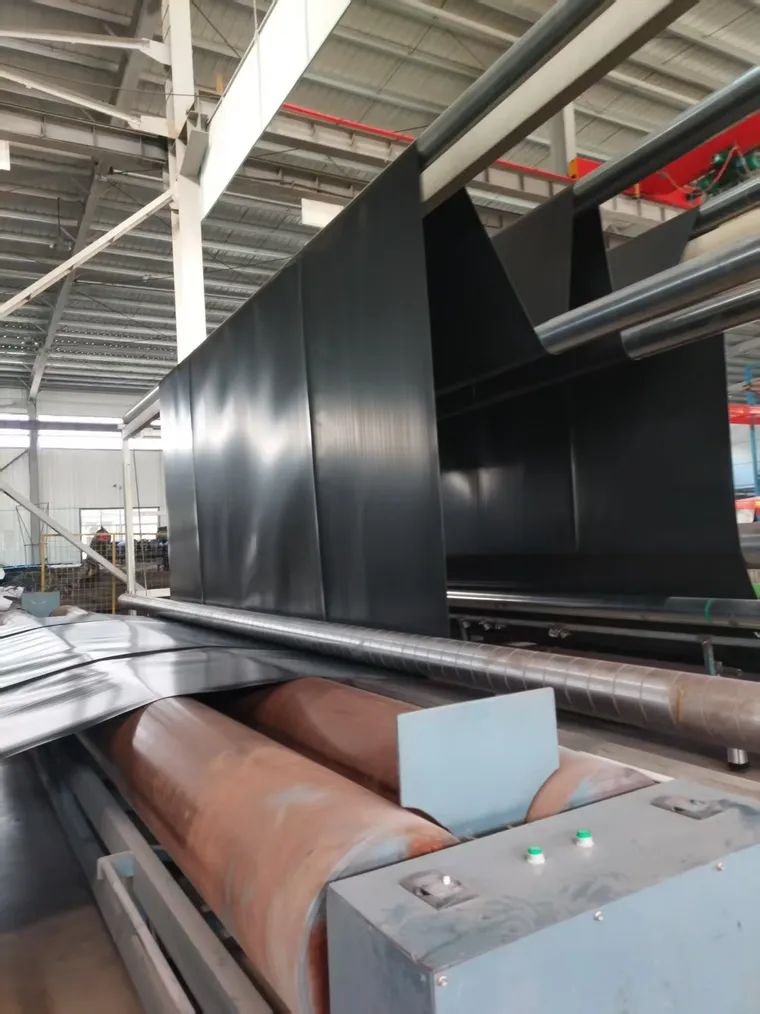
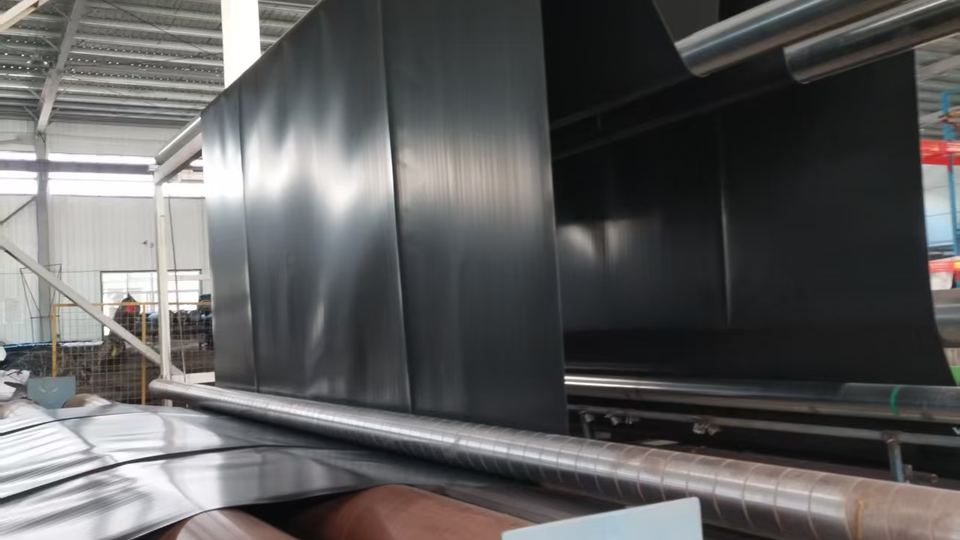
HDPE sheet as supplied
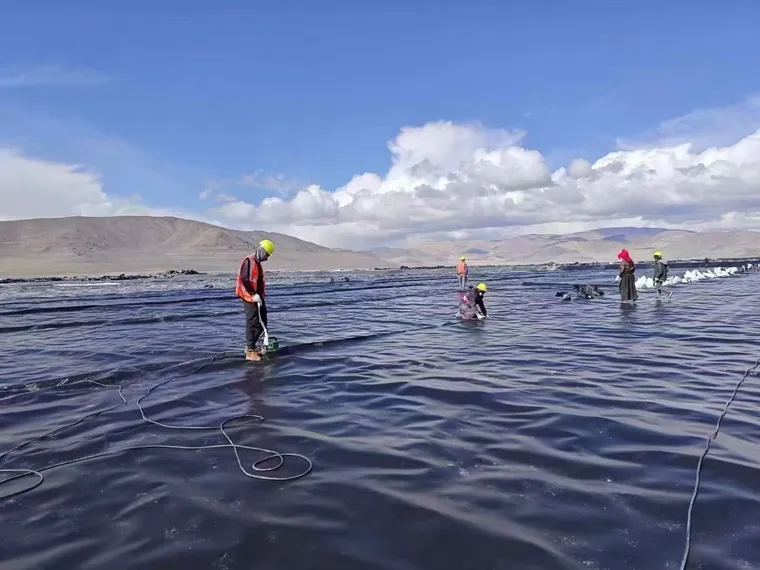
Panels being laid across a reservoir